How much does colocation cost in Ashburn and Northern Virginia?
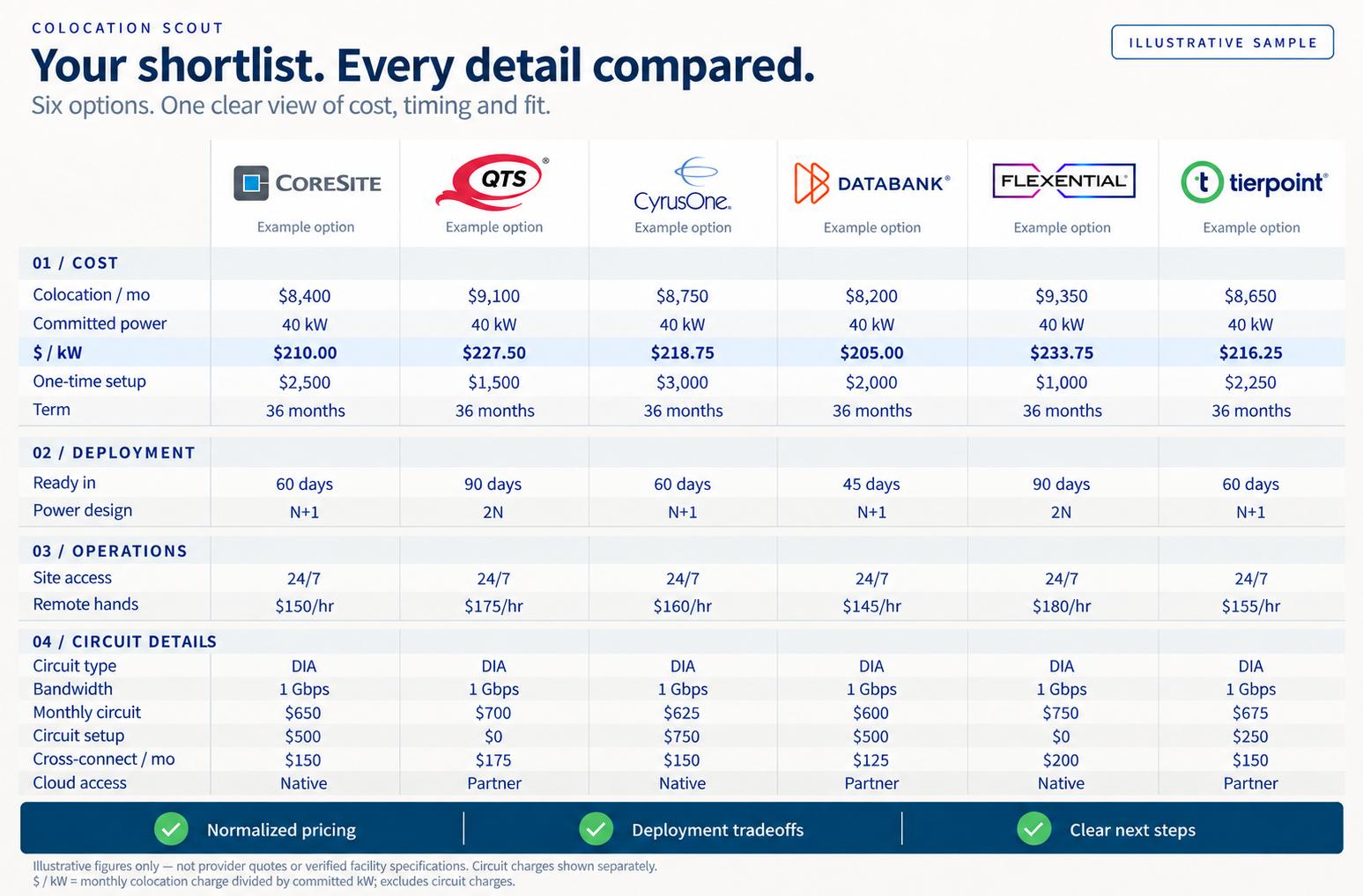
Recent quotes we received for Northeast ran $200 to $240 per kW per month for up to 500 kW, falling to $165 to $205 above 1 MW. CBRE's published asking band for Ashburn and Northern Virginia is $190 to $235 per kW per month for 250 to 500 kW.
| Deployment | Monthly rate | Source |
|---|---|---|
| Up to 500 kW | $200 to $240/kW-mo | Our quotes |
| Over 500 kW to 1 MW | $180 to $220/kW-mo | Our quotes |
| Over 1 MW | $165 to $205/kW-mo | Our quotes |
| 250 to 500 kW, asking rent | $190 to $235/kW-mo | CBRE, North America Data Center Trends H1 2026, first half of 2026 |
Smaller deployments cost more per kW. These are recent quotes we received, not a statement that space is available. Cross-connects, remote hands and one-time setup are extra. Operators often give 2–3 free months on a new term. See every region's quote ranges.
Ashburn cabinet and cage prices
Smaller deployments are priced per cabinet or per cage rather than per kW. These are not provider offers, and a building on this page is not a claim that space is available in it.
| Requirement | Monthly range | What it assumes |
|---|---|---|
| 1 to 2U | $125 to $240/mo | Basic power and internet allocation |
| Quarter or half cabinet | $1,050 to $1,425/mo | Shared cabinet environment |
| Standard full cabinet | $1,425 to $1,875/mo | Typical 3 to 5 kW commit |
| 10 to 20 kW high-density cabinet | $2,375 to $5,450/mo | Cooling method must be validated |
| Private cage | $5,225 to $22,750/mo | Four-rack starting profile; density drives spread |
Taxes, cross-connects, bandwidth and one-time charges are extra. How power is billed is covered in how colocation power is billed.
What the total monthly Ashburn cost includes
Space and power
Cabinet, cage or suite fee plus the committed power basis. Confirm whether the quote uses allocated, metered or usable IT load.
A/B delivery
Dual-corded service, redundancy topology and the treatment of reserved capacity can change both price and usable kW.
Network and support
Carrier bandwidth, cloud ports, cross-connect MRCs, remote hands and after-hours support are normally separate. For scale, Equinix's own federal price list puts a fiber cross connect at $282.12 a month; see Equinix cross connect pricing.
Install and term
Cage build, cabinets, cabling and turn-up charges affect year one. Model annual escalators, power pass-throughs and renewal language.
How long Ashburn space takes to deliver
Market-wide vacancy does not tell you whether a specific facility can deliver your density, cooling and date. The sourcing profiles below are search parameters, not representations of current inventory.
| Option | Footprint | Usable power | Cooling support | Estimated delivery |
|---|---|---|---|---|
| Cabinet search | 1 to 4 cabinets | 5 to 80 kW | Air or containment; liquid by review | Target 30 to 90 days |
| Cage search | 4 to 20 cabinets | 20 to 250 kW | Density-specific engineering review | Target 60 to 150 days |
| Suite search | 250 kW to 1 MW | Contracted usable kW to be defined | Air, RDHx or liquid-ready by facility | Target 6 to 24 months |
Get Ashburn colocation prices for your setup
Tell us the racks, power and timing you need. A scout comes back with matching Ashburn options and quoted prices.
Capacity operators are offering here
- 140 kW in Northern Virginia, available now (confirmed October 22, 2026) AC-002
Operator-reported and dated, not a reservation. The building is named on a call. See every listing.
Who is actually plugged in across Northern Virginia
A building existing and a building being connected are different facts, and only one of them decides whether your traffic can get where it needs to go cheaply. These figures come from PeeringDB, which the network operators themselves maintain, so every row below links to the building's own public entry.
| Measure | Figure | What it means |
|---|---|---|
| Buildings listed | 72 | Registered in PeeringDB across Northern Virginia, by 28 operators |
| Buildings with a network present | 59 | 13 carry no network presence, which usually means single tenant or simply unregistered |
| Network presences | 956 | Counted per building, so a carrier in three buildings counts three times |
| Internet exchange presences | 76 | Where you can reach many networks through one port instead of many cross-connects |
| Carrier presences | 72 | The physical transport choice you can buy without leaving the building |
| In the densest building | 55% | Equinix DC1-DC15,DC21-DC22 - Ashburn holds 523 of the market's network presences |
The most connected buildings here
| Networks | Building | Operator | Exchanges | Carriers |
|---|---|---|---|---|
| 523 | Equinix DC1-DC15,DC21-DC22 - Ashburn | Equinix, Inc. | 9 | 14 |
| 84 | CoreSite - Reston (VA1) | CoreSite | 6 | 5 |
| 38 | DataBank Ashburn (IAD1) | DataBank, Ltd. | 2 | 2 |
| 26 | RagingWire VA1 - NTT | RagingWire Data Centers - NTT | 1 | 2 |
| 21 | CoreSite - Reston (VA2) | CoreSite | 3 | 2 |
| 16 | CoreSite - Washington,DC (DC1) | CoreSite | 3 | 3 |
| 16 | Digital Realty IAD 39 (44274 Round Table) | Digital Realty | 3 | 3 |
| 15 | CoreSite - Reston (VA3) | CoreSite | 3 | 3 |
From PeeringDB, which is maintained by the network operators present in these buildings rather than by the landlords, which is what makes it worth more than a directory. Two limits. Entries are voluntary, so a building showing no networks may be single tenant or may simply never have registered. And a network being present says nothing about whether the building has space, power or a price for you: that is still a call.
Updated July 2026Why Ashburn is still the first market many teams check
Ashburn sits inside Northern Virginia's unusually dense data center and fiber ecosystem. For a buyer, that can mean broad carrier choice, established cloud connectivity, deep operator experience, and multiple ways to design for redundancy. It is especially useful when latency, interconnection, and access to East Coast users matter.
That depth does not make capacity easy to secure. CBRE reported that Northern Virginia reached 4,182 MW of inventory in Q1 2026, yet only 10.8 MW was available. The market vacancy rate was 0.3%. Those figures cover the wider Northern Virginia market, but they capture the practical Ashburn problem: new supply is being absorbed almost as quickly as it arrives.
A requirement with a hard date should be tested against live power, density, and network fit early. A building can have empty floor area and still lack the right deliverable power block.
Market figures: CBRE Global Data Center Trends 2026. Loudoun County also describes Data Center Alley as the world's largest concentration of data centers on its official data center page.
kW and MW, in plain English
Colocation capacity is usually discussed in committed electrical power, not square feet. One megawatt equals 1,000 kilowatts. The amount you need depends on the equipment load, redundancy design, rack density, cooling approach, and expected growth.
50 to 250 kW
A smaller enterprise footprint, disaster recovery environment, edge deployment, or a few cabinets through private cage colocation. Facility and contract minimums matter.
250 to 500 kW
A material enterprise deployment. This is also the requirement band used in CBRE's published Northern Virginia asking-rate benchmark.
500 kW to 2 MW
A larger private suite or phased deployment. Ramp schedules, adjacent expansion, and power-delivery dates become central commercial terms.
2 MW and above
Wholesale-scale capacity. Fewer facilities can deliver the block, and longer planning horizons or alternative Northern Virginia locations may be necessary.
What drives price in Ashburn
A monthly price per kW is useful for planning, but it is not the whole deal. Two quotes can use the same headline rate and still produce very different total costs.
- Size and commitment: larger power blocks can receive better unit economics, but they carry a larger minimum commitment.
- Term and ramp: longer terms can improve pricing. A staged power ramp can reduce early spend if the operator accepts it.
- Density and cooling: high-density racks, liquid cooling, or containment can narrow the facility set and add engineering costs.
- Redundancy: distribution design, backup architecture, and maintenance expectations influence both fit and cost.
- Network: cross-connects, carrier ports, cloud on-ramps, and diverse entrances are often quoted separately.
- One-time charges: installation, cages, cabinets, cabling, migration support, and custom security can materially change year-one spend.
- Escalators and renewals: annual increases and renewal language can outweigh a small difference in the opening rate.
What "available" should mean in your shortlist
A useful availability answer includes the quantity, delivery date, density, redundancy, physical layout, expansion path, and any work required before service starts. A broad statement such as "we have capacity in Ashburn" is not enough to build a project plan.
- Confirm the initial committed kW and expected ramp by date.
- Document the power density required per cabinet or row.
- Define network carriers, cloud connections, route diversity, and cross-connect count.
- Set compliance, physical security, access, and support requirements.
- Identify future expansion and whether adjacent capacity is contractual or only aspirational.
- Normalize recurring and one-time charges across every option.
When Ashburn may not be the right answer
Ashburn can be the strongest ecosystem and still be the wrong project fit. If the deployment needs a very large contiguous block, an aggressive delivery date, a different risk profile, or better unit economics than the current market supports, nearby or secondary markets deserve a parallel look. In Maryland, Frederick County is the large campus to test for a later date. Montgomery County suits a second site near people in the Maryland suburbs. Baltimore covers the BWI corridor. The comparison should include latency, network cost, staff access, workload dependencies, and migration risk, not power price alone.
Do not trade away a business-critical requirement just to keep an Ashburn address. Use Ashburn when the ecosystem creates real value for the workload.
Northern Virginia by the numbers
Ashburn sits inside the largest data center market on earth, and the scale is worth stating precisely because it explains both the depth of choice and the difficulty of securing capacity.
| Measure | Figure | Context |
|---|---|---|
| Total inventory | 4,182.0 MW | Largest market in the world, up 1,135.9 MW year over year |
| Overall vacancy | 0.3% | An all-time low for the market |
| 2026 supply already committed | 96% | Preleasing now extends into 2027 and beyond |
| Interconnect queue | 4 to 6 years | Dominion's batching process governs new large-load dates |
| Industrial power | $0.095 to $0.13/kWh | Among the higher US bands, and usually passed through |
| Data center land | $3.5M to $4.0M/acre | Best powered sites have exceeded $8M per acre |
Sources: CBRE on Northern Virginia extending its lead and CBRE Global Data Center Trends 2026. Land is anchored on two disclosed 2026 trades: Amazon at about $427.3M for roughly 122 acres, and Starwood Capital at $166.8M for 42 acres in Fairfax County. Power bands and queue lengths vary by substation and by how load is staged, so confirm both for a specific site.
The submarkets, and why they are not interchangeable
Treating Northern Virginia as one market is the most common planning error. Price, availability and delivery date differ enough between corridors that the choice of submarket is often a bigger decision than the choice of provider.
Ashburn and Data Center Alley
Loudoun County. The densest concentration of exchange points, carrier cross-connects and cloud on-ramps anywhere. Highest pricing and tightest availability, and CBRE notes zoning and entitlement limits now constrain expansion here.
Sterling and Dulles
Immediately adjacent, sharing much of the same fiber and cloud access. Usually the first alternative when an Ashburn postcode is preferred rather than required.
Manassas and Prince William
Campus-scale development and larger contiguous blocks. Entitlement friction is a genuine risk, so verify the delivery path rather than the announced pipeline.
Fauquier, Culpeper, Stafford, Spotsylvania
The emerging outer ring CBRE has identified as new areas of activity. Land and power on timelines the core cannot match, at the cost of drive time and carrier depth.
Emerging submarket activity and the zoning constraints in Loudoun and Prince William per CBRE on record-low vacancy and emerging Northern Virginia growth areas.
Why the power queue decides your project plan
In Northern Virginia the scarce resource is not land, buildings or capital. It is an energized connection, and the wait for one is long enough to govern the entire schedule.
Dominion Energy's transmission upgrades support record absorption, but its batching system continues to extend delivery timelines for new projects. A four to six year horizon for new large load means the practical question is not whether a provider has space, but whether they already hold energized capacity or a firm position in the queue. Those are very different products sold at similar-sounding rates.
Is this capacity energized today? If not, what is the contractual power date, which substation serves it, and what are the remedies if the date slips? A lower rate with a 2030 date is not competitive with a higher rate available in 2027, and the difference will not appear in a rate comparison.
What Northern Virginia gives you that other markets do not
The premium here buys specific, measurable things. It is worth paying when the workload uses them, and worth avoiding when it does not.
- Interconnection density: more exchange points, carrier cross-connects and cloud on-ramps than almost any location globally, which lowers the cost and latency of reaching networks and clouds.
- Operator choice: enough competing facilities that a normalized bid process produces real price tension, even in a tight market.
- Redundancy design options: multiple diverse buildings and entrances within a short distance, which makes active-active and campus-diverse architectures practical.
- Deep operational labor pool: mature staffing for remote hands, smart hands and migration support.
- Predictable engineering: operators here have delivered high-density and liquid-ready builds repeatedly, which reduces execution risk on unusual requirements.
If your workload is latency-sensitive, interconnection-heavy or needs East Coast user proximity, those advantages are real and the pricing follows from them. If it is a batch or archival workload that simply needs cheap, reliable megawatts, you are paying for capabilities you will not use. The pricing benchmarks page shows what the alternative markets cost on land, power and interconnect queue.
The local politics are now part of the risk
Data centers are a large enough share of the Northern Virginia tax base that public policy is a live variable in a long-term plan. In Loudoun County, data centers are expected to contribute nearly half of local property tax revenue in 2026. That fiscal dependence cuts both ways for a tenant.
On one hand, local governments have a strong incentive to keep the sector healthy. On the other, concentration has produced real zoning and entitlement resistance in Loudoun and Prince William, which CBRE cites as limiting the market's ability to capture demand. For a buyer, the practical effect is that pipeline announcements in these counties deserve more scepticism than elsewhere, and a firm delivery commitment matters more than a large announced pipeline.
What has been announced in Northern Virginia
Announcements are not filings. Nobody has to build what they announce, the figure is the one the developer chose to publish, and the date moves. They are here because megawatts are what a requirement is measured in, and because the size of what is coming changes who will take your call. Every figure below links to a published report that states it, and was checked against at least one other independent report before it was written down.
| Capacity | Operator | Project | What was announced |
|---|---|---|---|
| 144 MW | STACK Infrastructure | Loudoun County Campus | Two two-story buildings of 72 MW each on 122 acres in greater Ashburn, near Dulles, drawing on an on-site substation. The figure is the operator's own and appears identically in its press release, its campus brochure and the trade coverage that followed |
| 114 MW | EdgeCore Digital Infrastructure | Ashburn campus, on Maries Road and Moran Road in Sterling | Reports disagree and the row carries the smaller. The current plan is described as roughly 685,000 SF and 114 MW of critical IT load across two sites under two miles apart, with first delivery in 2026. EdgeCore's own earlier description of the campus was 720,000 SF supporting 144 MW. Both are in circulation, and the difference is a plan that changed rather than a number anyone misread. Critical IT load across two buildings, the lower of two published figures |
Prince William County has its own page, and the figures for Gainesville, Haymarket and Manassas moved there on 13 August 2026. Nothing was lost: NTT's Gainesville campus and Corscale's Gainesville Crossing are counted on that page rather than this one, so no building is counted twice. The county is still Northern Virginia in every buyer's usage, and the reason it sits apart is that the largest project ever announced in it is now dead, which needed the room to explain. See that page.
Announced capacity is collected by hand from trade reporting and company statements, and each figure links to the report it came from. It is kept apart from the permit record below and never added to it: one is a document a jurisdiction issued, the other is a plan a company published. Neither is availability.
Every Northern Virginia facility we track
317 data centers across Northern Virginia, from our verified inventory. It is the layer that says whether a building exists yet, which no permit record answers directly.
| Status | Facilities | What it means for a search |
|---|---|---|
| Operational | 160 | Standing and running. The only layer that can hold a requirement this year |
| Under construction | 35 | Steel is up. Reachable for a date 6 to 18 months out, and usually pre-leasing now |
| Planned | 122 | Announced or entitled, not yet built. Treat every date on these as a forecast |
| Building area on file | 87,332,902 SF | Across the 249 facilities where a size is recorded, of 317 |
| Largest single building | 2,294,300 SF | Corscale, Gainesville |
Operators with the most facilities here: Digital Realty (53), STACK Infrastructure (27), Equinix (24), CloudHQ (22), QTS (16), CyrusOne (15), NTT Global Data Centers (13), Iron Mountain Data Centers (10), Rowan Digital Infrastructure (9), TA Digital Group (9).
Where they cluster: Ashburn (101), Sterling (68), Manassas (55), Culpeper (10), Gainesville (10), Chantilly (9).
The largest buildings coming to this market
157 facilities here are under construction or planned. These are the ten largest by floor area, and a size on file is not a promise of a delivery date.
| Operator | Status | Building size | Where |
|---|---|---|---|
| NTT Global Data Centers | Under Construction | 2,000,000 SF | Gainesville, VA |
| PointOne Development Corp. | Planned | 1,800,000 SF | Remington, VA |
| TA Realty | Planned | 1,500,000 SF | Leesburg, VA |
| CloudHQ | Under Construction | 1,435,000 SF | Ashburn, VA |
| Aligned Data Centers | Under Construction | 1,300,000 SF | Frederick, MD |
| PowerHouse Data Centers | Planned | 1,131,350 SF | Dulles, VA |
| CloudHQ | Under Construction | 800,000 SF | Manassas, VA |
| PowerHouse Data Centers | Planned | 796,844 SF | Sterling, VA |
| DataBank | Planned | 795,700 SF | Culpeper, VA |
| Digital Realty | Under Construction | 794,000 SF | Sterling, VA |
From our verified inventory rather than from a public record, so these rows carry no filing link and street addresses are held back. These buildings are verified, which is not the same as their space being available: every facility above may be full, pre-leased, or closed to your size. Finding out is a call, not a lookup. See what a verified building does and does not mean.
What the public construction record shows in Northern Virginia
Loudoun County building permits plus Virginia air permits in the Northern Virginia counties. Every figure below is a count of filings we collected ourselves, and every row links to the record it came from.
| Measure | Figure | What it means |
|---|---|---|
| Filings we track | 765 | Deduplicated. Across 3 sources, August 1984 to October 2026 |
| Filed in the last 12 months | 321 | The live rate of construction activity, which is the number that moves |
| Tenant fit-out filings | 520 | A customer is landing in a named building. The strongest signal in the set |
| New building filings | 80 | Shell and site work, which is capacity two years out, not now |
| Distinct addresses | 159 | Separate sites in the record, not separate buildings |
| Largest capacity in the record | 96 MW | Stated on 6 of 765 filings. Capacity is rarely published, so this is a floor, not a market total |
| Largest floor area filed | 2,242,904 SF | One permit, not a campus total. Floor area is published far more often than capacity |
| Operators we can name | 15 | 92 of 765 filings name a recognizable operator. The rest name an engineer, a builder or a holding company |
| Filings with no date published | 1 | The source publishes the facility, not the filing date |
Operators appearing by name: Amazon Web Services (27), CyrusOne (26), QTS (14), Vantage Data Centers (5), Equinix (4), STACK Infrastructure (3), AT&T (2), EdgeCore (2).
The filings that state a capacity
Most permits never mention megawatts. These do, and the basis matters: a figure the applicant stated for the project is a different claim from a generator nameplate, which is backup plant rather than sellable load.
| Capacity | Basis | The filing |
|---|---|---|
| 96 MW | Capacity stated in the filing | New build 2-story 96 MW data center on existing campus for CloudHQ. Will include ma |
| 36 MW | Capacity stated in the filing | ...Tenant Improvements Include The Interior Fit Out Of Three Existing 36 MW Data Halls And Office Spaces With An Approximate Tota... |
| 14 MW | Capacity stated in the filing | Data Hall fitout of 14 MW across 2 floors. |
| 14 MW | Capacity stated in the filing | Data Hall fitout of 14 MW across 2 floors. |
| 14 MW | Capacity stated in the filing | ...Hall build out for three 14 MW's (92,748 sq. ft. total), which contains busway and hot ais |
| 12 MW | Capacity stated in the filing | Data Hall build out for two 12 MW's, which contains busway and hot aisle containment. Phase 3 |
The most recent filings on the record
Collected from Loudoun County LandMARC permit records, Virginia DEQ air permit records and Fairfax County PLUS planning records. A permit or air-register entry documents a site or proposed work. It does not establish current construction or available space, and no public filing anywhere discloses what is contractible at a named building. That answer comes from an operator call, which is the part we do by hand. See how we verify capacity.