How much does colocation cost in Atlanta?
Recent quotes we received for Southeast ran $180 to $220 per kW per month for up to 500 kW, falling to $140 to $160 above 1 MW. CBRE's published asking band for Atlanta is $185 to $200 per kW per month for 250 to 500 kW.
| Deployment | Monthly rate | Source |
|---|---|---|
| Up to 500 kW | $180 to $220/kW-mo | Our quotes |
| Over 500 kW to 1 MW | $160 to $190/kW-mo | Our quotes |
| Over 1 MW | $140 to $160/kW-mo | Our quotes |
| 250 to 500 kW, asking rent | $185 to $200/kW-mo | CBRE, North America Data Center Trends H1 2026, first half of 2026 |
Smaller deployments cost more per kW. These are recent quotes we received, not a statement that space is available. Cross-connects, remote hands and one-time setup are extra. Operators often give 2–3 free months on a new term. See every region's quote ranges.
Atlanta cabinet and cage prices
Smaller deployments are priced per cabinet or per cage rather than per kW. These are not provider offers, and a building on this page is not a claim that space is available in it.
| Requirement | Monthly range | What it assumes |
|---|---|---|
| 1 to 2U | $125 to $240/mo | Basic power and internet allocation |
| Quarter or half cabinet | $1,050 to $1,425/mo | Shared cabinet environment |
| Standard full cabinet | $1,425 to $1,800/mo | Typical 3 to 5 kW commit |
| 10 to 20 kW high-density cabinet | $2,375 to $4,950/mo | Cooling method must be validated |
| Private cage | $5,225 to $19,000/mo | Four-rack starting profile; density drives spread |
Taxes, network, cross-connects and one-time costs are extra. How power is billed is covered in how colocation power is billed.
What the total monthly Atlanta cost includes
Cabinet and usable power
Confirm the included cabinet or floor space and the usable IT load after redundancy and operating limits.
A/B and cooling
Dual feeds, containment, RDHx and liquid distribution can add design work, equipment and minimum commitments.
Network and remote hands
Model bandwidth, cross-connect recurring charges, cloud ports, installation labor and support minimums.
Install and escalators
Add cages, cabinets, cabling, deposits, turn-up fees, annual increases and power-related pass-throughs.
How long Atlanta space takes to deliver
Market-wide vacancy does not tell you whether a specific facility can deliver your density, cooling and date. The sourcing profiles below are search parameters, not representations of current inventory.
| Option | Footprint | Usable power | Cooling support | Estimated delivery |
|---|---|---|---|---|
| Cabinet search | 1 to 4 cabinets | 5 to 80 kW | Air or containment; liquid by review | Target 30 to 90 days |
| Cage search | 4 to 20 cabinets | 20 to 250 kW | Density-specific engineering review | Target 60 to 150 days |
| Suite search | 250 kW to 1 MW | Contracted usable kW to be defined | Air, RDHx or liquid-ready by facility | Target 4 to 20 months |
Get Atlanta colocation prices for your setup
Tell us the racks, power and timing you need. A scout comes back with matching Atlanta options and quoted prices.
Capacity operators are offering here
- 500 kW in Atlanta, available now (confirmed October 22, 2026) AC-010
Operator-reported and dated, not a reservation. The building is named on a call. See every listing.
What providers in Atlanta post as a list price
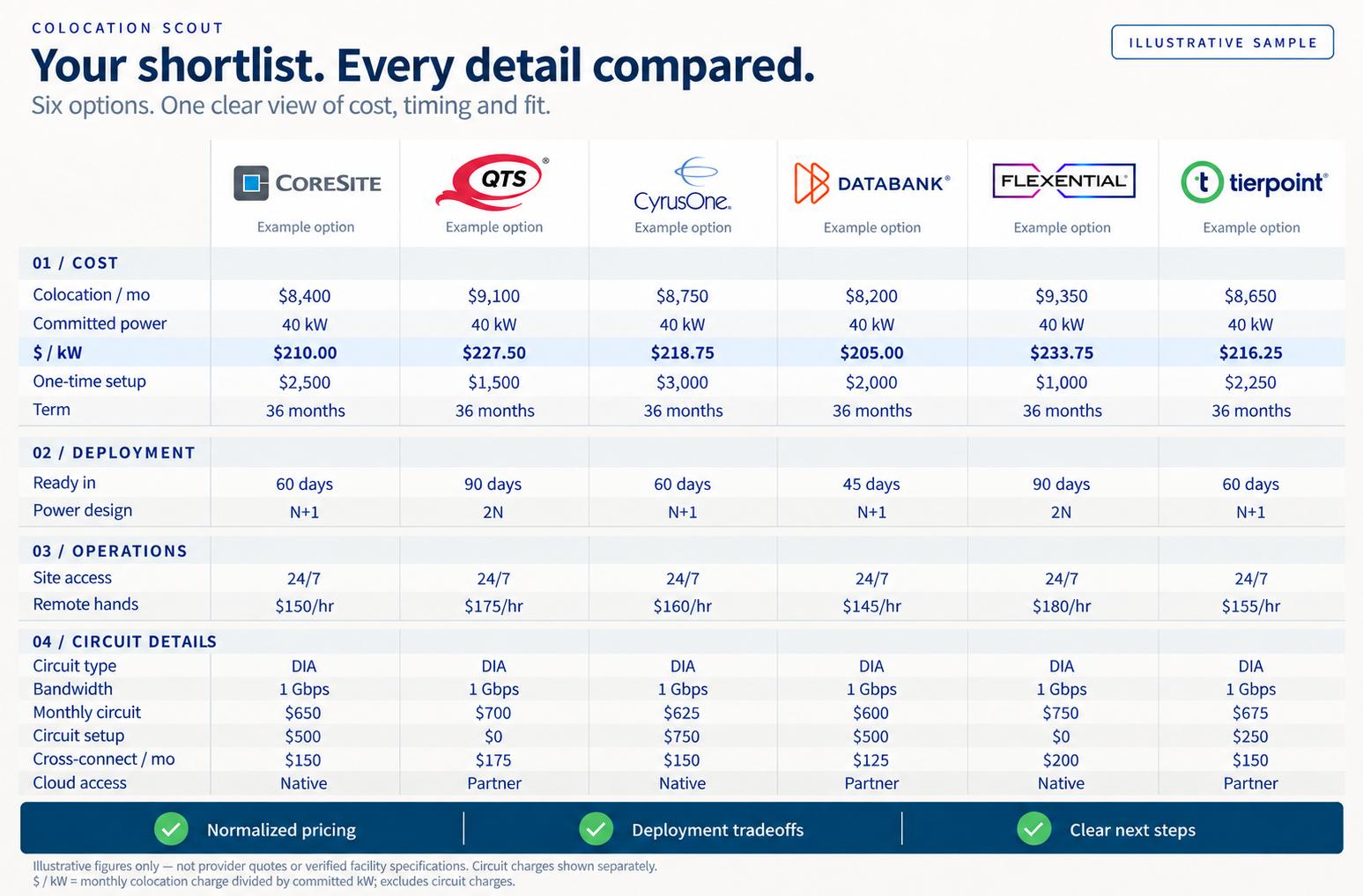
Most colocation in Atlanta is quoted, not posted. The provider below is the exception: it publishes a monthly price on its own website, and every row links to that page. It is a smaller regional operator. The large operators here do not publish prices at all, so read these as a floor and a sanity check, not as what an enterprise contract lands at.
| Monthly | Provider | Offer | Power included | Per usable kW | Bandwidth |
|---|---|---|---|---|---|
| $1,249 | Cyber Wurx | Full cabinet, 42U. CoreSite AT2, Atlanta | 20A at 120V (1.92 kW usable) | $651 | 1 Gbps |
| $2,099 | Cyber Wurx | Full cabinet, 42U, A+B power. CoreSite AT2, Atlanta | 30A at 208V, A+B (4.99 kW usable) | $420 | 1 Gbps |
Each price was read on the provider's own page on the date shown. Usable kW is 80% of the circuit rating, with a redundant A+B pair counted once, and is only worked out where the provider states both amps and volts. "From" is the provider's own word for a starting price. Providers whose networks carry spam or abuse flags are left out whatever their price. A posted price is not availability, and bundles differ in bandwidth and power, so compare the whole row rather than the first column. How power is billed is covered in how colocation power is billed.
Send it over and a scout will tell you how it compares with these posted prices and with the published benchmarks for this market. There is no obligation.
Who is actually plugged in across Atlanta
A building existing and a building being connected are different facts, and only one of them decides whether your traffic can get where it needs to go cheaply. These figures come from PeeringDB, which the network operators themselves maintain, so every row below links to the building's own public entry.
| Measure | Figure | What it means |
|---|---|---|
| Buildings listed | 40 | Registered in PeeringDB across Atlanta, by 22 operators |
| Buildings with a network present | 34 | 6 carry no network presence, which usually means single tenant or simply unregistered |
| Network presences | 586 | Counted per building, so a carrier in three buildings counts three times |
| Internet exchange presences | 34 | Where you can reach many networks through one port instead of many cross-connects |
| Carrier presences | 56 | The physical transport choice you can buy without leaving the building |
| In the densest building | 33% | Digital Realty ATL13 - Atlanta holds 191 of the market's network presences |
The most connected buildings here
| Networks | Building | Operator | Exchanges | Carriers |
|---|---|---|---|---|
| 191 | Digital Realty ATL13 - Atlanta | Digital Realty | 4 | 7 |
| 77 | Digital Realty ATL14 - Atlanta | Digital Realty | 3 | 7 |
| 69 | CoreSite - Atlanta (AT1) | CoreSite | 4 | 4 |
| 61 | Equinix AT1 - Atlanta | Equinix, Inc. | 3 | 6 |
| 23 | Equinix AT2/AT3 - Atlanta | Equinix, Inc. | 1 | 3 |
| 22 | QTS Atlanta-Metro (ATL1) | QTS Realty Trust, Inc. | 2 | 3 |
| 14 | EdgeConneX Atlanta (EDCATL01) | EdgeConneX Inc. | 1 | 1 |
| 12 | Cogent Atlanta | Cogent Communications, Inc. | 1 | 2 |
From PeeringDB, which is maintained by the network operators present in these buildings rather than by the landlords, which is what makes it worth more than a directory. Two limits. Entries are voluntary, so a building showing no networks may be single tenant or may simply never have registered. And a network being present says nothing about whether the building has space, power or a price for you: that is still a call.
Q1 2026 market profileWhy Atlanta has become a primary market
Atlanta now combines large-market scale with a strategic Southeast location, abundant regional fiber routes, cloud and enterprise demand, and continued development beyond the traditional core. It can serve East Coast and southern users while providing a credible alternative to Northern Virginia for many architectures.
CBRE reported 1,465.2 MW of Atlanta inventory in Q1 2026, up 14.5% year over year. Vacancy fell to 1%, and only 14.5 MW remained available across the market. Hyperscale and AI leasing continued to absorb new capacity and push rates higher across requirement sizes.
1,465.2 MW
Total wholesale inventory, making Atlanta the second-largest U.S. colocation market.
14.5% growth
Year-over-year inventory expansion through Q1 2026.
1.0% vacancy
One of the tightest vacancy rates among major U.S. markets.
14.5 MW available
Market-wide available supply after continued leasing activity.
Source: CBRE Global Data Center Trends 2026. Figures describe the metro market, not a specific facility.
Atlanta's long-term power story
CBRE identifies Georgia Power's approvals for substantial new generation as a long-term opportunity for the market. That matters for future expansion, but generation approval and deliverable facility capacity are not the same thing. Large-load rules, financial guarantees, transmission, interconnection, and site-level infrastructure still affect schedule and commercial risk.
For a near-term requirement, ask what is already deliverable. Treat future generation as strategic context until the operator can document the utility and construction path for your phase.
Where Atlanta is expanding
Atlanta's data center geography continues to broaden. CBRE points to land availability and fiber routes in the southern suburbs as a major development opportunity. Those locations can support larger campuses and future growth, while established metro facilities may offer stronger immediate interconnection or enterprise proximity.
The right submarket depends on what the workload needs most: live power, carrier density, cloud proximity, airport and staff access, a large expansion envelope, or geographic separation from another site. A metro-wide label is not precise enough for the shortlist.
What drives an Atlanta colocation quote
- Required power block, delivery date, and ramp schedule.
- Live capacity versus capacity tied to future utility or construction milestones.
- Rack density, cooling design, and support for high-density infrastructure.
- Facility location, carrier ecosystem, cloud access, and diverse network routes.
- Cage, suite, dedicated hall, or wholesale configuration.
- Installation, cross-connects, remote hands, annual increases, and renewal terms.
- Expansion rights and whether future space and power are contractually reserved.
When Atlanta is the strongest fit
Atlanta is especially compelling for Southeast operations, East Coast application delivery, cloud-adjacent workloads, and buyers who need a major ecosystem without defaulting to Northern Virginia. It also deserves attention as a geographically distinct disaster-recovery or secondary region, subject to the organization's latency and risk requirements.
Compare Atlanta with Northern Virginia when interconnection and East Coast reach lead the decision. Compare it with Dallas-Fort Worth when southern scale, land, and future campus growth matter. Compare it with Chicago when the choice is primarily about central versus southeastern application and operations geography.
For a smaller Southeast requirement, Alabama is worth a look. Huntsville and Birmingham both have operating colocation.
Risks to resolve before shortlisting a facility
- Capacity timing: 1% market vacancy means the right block may require early commitment.
- Utility conditions: understand large-load requirements, guarantees, and dependencies behind the delivery date.
- Regulatory change: tax incentives and grid-expansion policy continue to receive scrutiny.
- Submarket tradeoffs: outer-campus scale can come with a different network and staffing profile.
- Expansion certainty: distinguish a provider roadmap from reserved contractual capacity.
A facility-ready Atlanta brief
- Initial kW or MW and the three-to-five-year growth curve.
- Rack density, cooling, redundancy, and sustainability requirements.
- Target date and acceptable utility or construction dependencies.
- Carrier, cloud, latency, cross-connect, and route-diversity needs.
- Security, compliance, site access, and operating-support expectations.
- Commercial term, ramp, expansion, renewal, and escalator priorities.
Test established and southern-growth submarkets at the same time. Let live capacity, network fit, and commercial certainty decide whether proximity or future scale creates more value.
Atlanta by the numbers
Atlanta became the second-largest data center market in the United States in about three years. The scale of that shift is the single most useful thing to understand about the market, because it explains both the pricing advantage and why the advantage is shrinking.
| Measure | Figure | Context |
|---|---|---|
| Total inventory | 1,459.2 MW | Second-largest US market, up 458.8 MW year over year |
| Under construction | 2,076 MW | Larger than the operating market itself |
| Overall vacancy | 1.0% | Down from 3.6%, the steepest fall of any major market |
| Asking rent change | Up 2% | The mildest of the top four markets in Q1 2026 |
| Long-term power commitments | More than 3 GW | Supporting the pipeline, staged over years |
| Statewide growth cleared | More than 10 GW | Following Georgia Public Service Commission approvals |
Sources: CBRE on Atlanta as one of North America's fastest growing hubs, CBRE on Atlanta's record-high pipeline and CBRE Global Data Center Trends 2026. Inventory is a wholesale colocation figure and excludes owner-occupied hyperscale capacity.
Atlanta has more megawatts under construction than it currently operates. That sounds like future relief, and it mostly is not. Roughly 80% of North American space under construction is already preleased, and local reporting describes Atlanta buildings filling as soon as they are delivered. Read the pipeline as evidence of sustained growth, not as inventory you can shop.
The submarkets, and what each is good for
Development here is concentrated in a few corridors rather than spread across the metro. Which corridor suits you depends on whether you are buying network density or megawatts.
Douglasville and Lithia Springs
The west corridor, and the center of hyperscale-scale activity, with Microsoft and Google campuses anchoring it. Where the largest contiguous blocks and campus deals are found.
Atlanta core and midtown
Carrier hotels and network-dense colocation. The right answer for interconnection, peering and latency-sensitive workloads.
Alpharetta and Norcross
North suburban enterprise colocation in established multi-tenant facilities. Suited to cabinet and cage requirements rather than multi-megawatt blocks.
Outer metro corridors
Where new land and power commitments are being staged. Availability the core corridors cannot match, with longer timelines and thinner carrier choice.
Why Atlanta wins deals, and where it does not
Hyperscale demand here is driven by three things: lower power costs than the coastal markets, dense fiber routes running through the Southeast, and consistent tax treatment. For an enterprise buyer the same logic applies at smaller scale.
- Power economics: the reason large requirements land here. Confirm the tariff and the pass-through mechanism for your specific hall, not the market average.
- Rate stability: 2% annual growth against 14.7% in Chicago and 12.5% nationally for large blocks. For a multiyear term this is a materially different risk profile.
- Equipment tax treatment: Georgia offers a sales and use tax exemption on qualifying data center equipment, which affects year-one cost rather than rent. Verify thresholds and your own qualification with a tax advisor, and model the case without it.
- Growth headroom: more than 10 GW of statewide growth cleared by the Public Service Commission, which is a genuine long-term signal.
Where Atlanta does not win is interconnection depth. It is a strong network market, but it is not Ashburn, and a workload that depends on the widest possible carrier and cloud on-ramp choice will find fewer options. It is also no longer a cheap market in absolute terms: 1.0% vacancy means you are competing for capacity here too.
What to watch next
Three things will decide whether Atlanta's pricing advantage over Northern Virginia persists.
First, whether the 2,076 MW pipeline delivers on schedule or slips into the same power-delivery friction other markets face. Second, whether rate growth stays in the low single digits once the current wave of preleased capacity is absorbed, since a market growing this fast rarely stays this cheap. Third, whether the local politics follow the pattern set in Northern Virginia, where concentration eventually produced zoning resistance. Metro Atlanta is already having a public debate about the tradeoffs of hosting this much capacity, and that debate tends to precede tighter entitlement conditions.
None of that argues against Atlanta today. It argues for locking a term while rates are rising at 2% rather than assuming the discount will still be there at renewal. The pricing benchmarks page tracks the published figures across markets so you can see the gap move.
What has been announced in Atlanta
Announcements are not filings. Nobody has to build what they announce, the figure is the one the developer chose to publish, and the date moves. They are here because megawatts are what a requirement is measured in, and because the size of what is coming changes who will take your call. Every figure below links to a published report that states it, and was checked against at least one other independent report before it was written down.
| Capacity | Operator | Project | What was announced |
|---|---|---|---|
| 324 MW | Microsoft | Union City campus | Three buildings, $1.8bn, southwest of Atlanta |
| 108 MW | Grindcap | Bells Ferry Road, Marietta | Two buildings on a former cell tower site, rezoning approved June 2025. Announced capacity, 72 MW of it IT load |
The Marietta project is the clearest example on this page of why the headline number needs reading twice. It is announced as 108 MW. The IT load across its two buildings is 72 MW, and the rest is everything that is not your equipment.
Announced capacity is collected by hand from trade reporting and company statements, and each figure links to the report it came from. It is kept apart from the permit record below and never added to it: one is a document a jurisdiction issued, the other is a plan a company published. Neither is availability.
Every Atlanta facility we track
153 data centers across Atlanta, from our verified inventory. It is the layer that says whether a building exists yet, which no permit record answers directly.
| Status | Facilities | What it means for a search |
|---|---|---|
| Operational | 51 | Standing and running. The only layer that can hold a requirement this year |
| Under construction | 14 | Steel is up. Reachable for a date 6 to 18 months out, and usually pre-leasing now |
| Planned | 88 | Announced or entitled, not yet built. Treat every date on these as a forecast |
| Building area on file | 27,563,499 SF | Across the 84 facilities where a size is recorded, of 153 |
| Largest single building | 995,728 SF | Digital Realty, Atlanta |
Operators with the most facilities here: Digital Realty (19), QTS (15), T5 Data Centers (11), CyrusOne (9), DC Blox (9), Equinix (9), Prologis (9), DataBank (7), Stream Data Centers (7), EdgeConneX (5).
Where they cluster: Atlanta (36), Lithia Springs (16), Taylorsville (12), Fayetteville (10), Winston (10), Newnan (9).
The largest buildings coming to this market
102 facilities here are under construction or planned. These are the ten largest by floor area, and a size on file is not a promise of a delivery date.
| Operator | Status | Building size | Where |
|---|---|---|---|
| DartPoints | Planned | 774,610 SF | Atlanta, GA |
| Vantage Data Centers | Planned | 754,222 SF | Atlanta, GA |
| Vantage Data Centers | Planned | 711,324 SF | College Park, GA |
| EdgeConneX | Under Construction | 700,500 SF | Union City, GA |
| EdgeConneX | Planned | 700,500 SF | Union City, GA |
| EdgeConneX | Planned | 700,500 SF | Union City, GA |
| DartPoints | Planned | 656,000 SF | Atlanta, GA |
| DartPoints | Planned | 586,256 SF | Atlanta, GA |
| Aligned Data Centers | Planned | 566,000 SF | Winston, GA |
| Aligned Data Centers | Planned | 566,000 SF | Winston, GA |
From our verified inventory rather than from a public record, so these rows carry no filing link and street addresses are held back. These buildings are verified, which is not the same as their space being available: every facility above may be full, pre-leased, or closed to your size. Finding out is a call, not a lookup. See what a verified building does and does not mean.
What the public construction record shows in Atlanta
Georgia EPD air permits, which is the layer that names the operator. Every figure below is a count of filings we collected ourselves, and every row links to the record it came from.
| Measure | Figure | What it means |
|---|---|---|
| Filings we track | 53 | Deduplicated. Across 2 sources, June 1999 to June 2026 |
| Filed in the last 12 months | 4 | The live rate of construction activity, which is the number that moves |
| Distinct addresses | 2 | Separate sites in the record, not separate buildings |
| Operators we can name | 12 | 45 of 53 filings name a recognizable operator. The rest name an engineer, a builder or a holding company |
| Filings with no date published | 2 | The source publishes the facility, not the filing date |
Operators appearing by name: Google (10), Microsoft (8), Vantage Data Centers (8), AT&T (4), Amazon Web Services (3), QTS (3), Edged Energy (2), Flexential (2).
The most recent filings on the record
| Filed | Named on the filing | What it says | Type |
|---|---|---|---|
| 30 June 2026 | Equinix | Equinix Atlanta Data Center | Power and cooling |
| 29 June 2026 | Amazon Web Services | Amazon Data Services, Inc. ATL089 Campus | Power and cooling |
| 5 May 2026 | Flexential | Flexential Corporation | Power and cooling |
| 10 February 2026 | Edged Energy | Edged Energy Atlanta Data Center | Power and cooling |
| 18 August 2025 | Amazon Web Services | Amazon Data Services, Inc. ATL068 and ATL078 Campuses | Power and cooling |
| 6 June 2025 | Not an identifiable operator | DB Data Center Boulder Park, LLC | Power and cooling |
| 4 June 2025 | Microsoft | Microsoft Corporation- CCO06 Facility | Power and cooling |
| 6 May 2025 | Vantage Data Centers | Vantage Data Centers GA1, LLC | Power and cooling |
Collected from Georgia EPD air permit search and Atlanta and Fulton County land disturbance records. A permit or air-register entry documents a site or proposed work. It does not establish current construction or available space, and no public filing anywhere discloses what is contractible at a named building. That answer comes from an operator call, which is the part we do by hand. See how we verify capacity.