How much does colocation cost in South Florida?
Recent quotes we received for Southeast ran $180 to $220 per kW per month for up to 500 kW, falling to $140 to $160 above 1 MW.
| Deployment | Monthly rate | Source |
|---|---|---|
| Up to 500 kW | $180 to $220/kW-mo | Our quotes |
| Over 500 kW to 1 MW | $160 to $190/kW-mo | Our quotes |
| Over 1 MW | $140 to $160/kW-mo | Our quotes |
The Southeast Region ranges cover Florida. They are regional planning figures, not a Miami-specific asking-rent benchmark; compare the building, power commitment and network charges in each quote.
Smaller deployments cost more per kW. These are recent quotes we received, not a statement that space is available. Cross-connects, remote hands and one-time setup are extra. Operators often give 2–3 free months on a new term. See every region's quote ranges.
South Florida cabinet and cage requirements
For a Miami cabinet or cage, name the networks you need to reach before comparing the monthly total. Include cross-connects, transit and remote hands, and confirm the building's storm procedures and power terms.
| Requirement | Quote basis | Include in the comparison |
|---|---|---|
| 1 to 2U or a partial cabinet | Rack units, usable power and bandwidth allocation | Access, remote hands and transfer limits |
| Full cabinet | Usable kW, circuit arrangement and contract term | Power billing, setup and monthly cross-connect charges |
| High-density cabinet | Usable kW per rack and the approved cooling design | Engineering approval, cooling charges and delivery date |
| Private cage | Rack count, total usable kW and expansion space | Carrier connections, remote hands and storm procedures |
Ask the operator to itemize electricity, taxes, bandwidth, cross-connects, remote hands and one-time charges. See how colocation power is billed.
Get South Florida colocation prices for your setup
Tell us the racks, power and timing you need. A scout comes back with matching South Florida options and quoted prices.
What providers in South Florida post as a list price
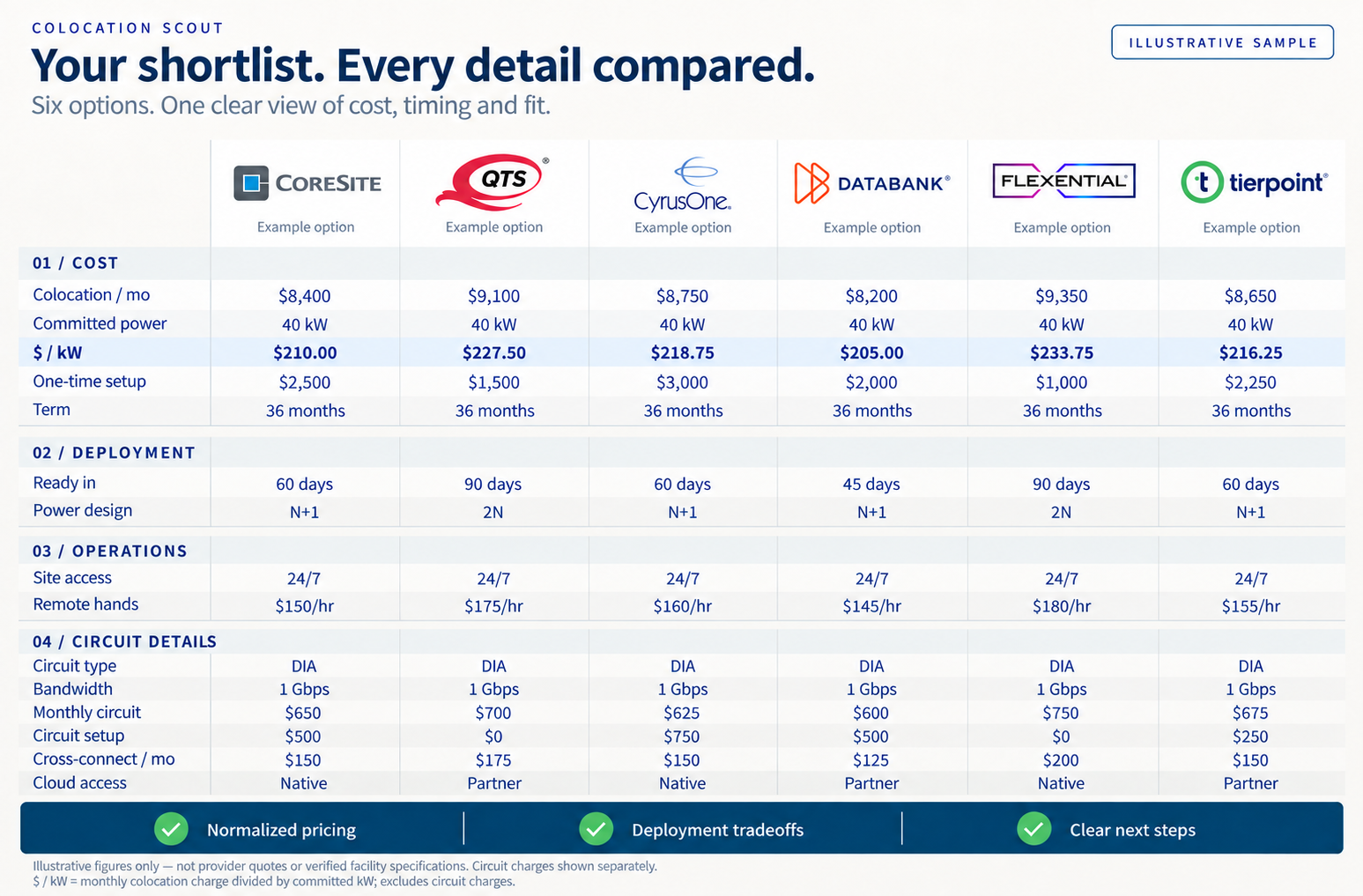
Most colocation in South Florida is quoted, not posted. The provider below is the exception: it publishes a monthly price on its own website, and every row links to that page. It is a smaller regional operator. The large operators here do not publish prices at all, so read these as a floor and a sanity check, not as what an enterprise contract lands at.
| Monthly | Provider | Offer | Power included | Per usable kW | Bandwidth |
|---|---|---|---|---|---|
| $54.95 | ServerPronto | Single server, 1U. Miami | 1A, voltage and redundancy not stated | Power not stated | 2.5 TB / 7.5 Mbps transfer; 100 Mbps port |
| $609.95 | ServerPronto | Half rack, 22U. Miami | 10A, voltage and redundancy not stated | Power not stated | 30 Mbps transfer allowance; 100 Mbps port |
| $989.95 | ServerPronto | Full private rack, 44U. Miami | 20A, voltage and redundancy not stated | Power not stated | 30 Mbps transfer allowance; 100 Mbps port |
Each price was read on the provider's own page on the date shown. Usable kW is 80% of the circuit rating, with a redundant A+B pair counted once, and is only worked out where the provider states both amps and volts. "From" is the provider's own word for a starting price. Providers whose networks carry spam or abuse flags are left out whatever their price. A posted price is not availability, and bundles differ in bandwidth and power, so compare the whole row rather than the first column. How power is billed is covered in how colocation power is billed.
Send it over and a scout will tell you how it compares with these posted prices and with the published benchmarks for this market. There is no obligation.
What a Miami government contract specifies for space and power
Miami-Dade County's approved 2026 Equinix MI1 price schedule separates the cage from its electrical circuits. It gives a concrete example of how a downtown Miami deployment is billed.
| Contract line | Monthly charge | Scope |
|---|---|---|
| 208V, 30A, single-phase circuit | $868.22 each | Primary and redundant feeds charged separately at this rate |
| 208V, 30A, three-phase circuit | $1,296.54 each | Primary and redundant feeds charged separately at this rate |
| 120V, 20A, single-phase circuit | $223.81 each | Primary circuit in the schedule |
| 12-cabinet private cage with circuit-based power | $41,467.30 total | Includes the deployment's circuit charges; connectivity is separate |
For example, a primary and redundant pair of the 208V, 30A single-phase circuits costs $1,736.44 a month before cage and network charges. Applying an 80% continuous-load allowance gives about 4.99 kW of protected load: one feed must carry that load if the other fails. Adding the two feeds' ratings would overstate the usable power.
Source: Miami-Dade County Resolution R-389-26, adopted May 5, 2026, Appendix C, PDF pages 33–36. The attached order is marked draft; these are the county-approved schedule's rates for a particular existing deployment, not a new-customer offer or a Miami market average. Internet, Fabric services and cross-connects have separate charges. The A+B example is our calculation. See the contract comparison and power-billing explanation.
Who is actually plugged in across South Florida
A building existing and a building being connected are different facts, and only one of them decides whether your traffic can get where it needs to go cheaply. These figures come from PeeringDB, which the network operators themselves maintain, so every row below links to the building's own public entry.
| Measure | Figure | What it means |
|---|---|---|
| Buildings listed | 30 | Registered in PeeringDB across South Florida, by 22 operators |
| Buildings with a network present | 23 | 7 carry no network presence, which usually means single tenant or simply unregistered |
| Network presences | 576 | Counted per building, so a carrier in three buildings counts three times |
| Internet exchange presences | 40 | Where you can reach many networks through one port instead of many cross-connects |
| Carrier presences | 42 | The physical transport choice you can buy without leaving the building |
| In the densest building | 58% | Equinix MI1 - Miami, NOTA holds 336 of the market's network presences |
The most connected buildings here
| Networks | Building | Operator | Exchanges | Carriers |
|---|---|---|---|---|
| 336 | Equinix MI1 - Miami, NOTA | Equinix, Inc. | 10 | 16 |
| 41 | ColoHouse Miami | ColoHouse Premier Datacenter | 3 | 1 |
| 33 | Digital Realty MIA (36 NE 2nd St) | Digital Realty | 4 | 1 |
| 26 | Equinix MI2 - Miami | Equinix, Inc. | 3 | 2 |
| 22 | DataBank Miami (MIA1) | DataBank, Ltd. | 2 | 0 |
| 21 | CoreSite - Miami (MI1) | CoreSite | 2 | 2 |
| 17 | iM Critical Miami | iM Critical | 1 | 2 |
| 15 | Equinix MI3 - Miami, Boca Raton | Equinix, Inc. | 2 | 4 |
From PeeringDB, which is maintained by the network operators present in these buildings rather than by the landlords, which is what makes it worth more than a directory. Two limits. Entries are voluntary, so a building showing no networks may be single tenant or may simply never have registered. And a network being present says nothing about whether the building has space, power or a price for you: that is still a call.
Market profileThe cables come ashore here, so the networks do too
South Florida is not a power market that grew networks. It is a landing point that grew a small power market around itself. Subsea systems from Latin America and the Caribbean come ashore in Florida, and that traffic has to be handed off to terrestrial carriers somewhere. That somewhere is a short list of buildings in Miami-Dade, Broward and Palm Beach counties.
The NAP of the Americas, now Equinix MI1, is the anchor. It is a purpose-built carrier hotel in downtown Miami, and it is the reason a network operator in Bogota or Sao Paulo buys space in Florida at all. The current interconnection snapshot lists 30 facilities across the market, with 23 reporting network presence. Its 576 network presences count a network again when it appears in another building. Compare the specific carriers and exchanges at each address rather than treating that sum as unique networks.
The cable landings are spread wider than the colocation is. Boca Raton is the terminal station for the SAm-1 system to South America. Hollywood, between Miami and Fort Lauderdale, is a landing point for MAYA-1, which serves Central America and the Caribbean and is being upgraded as MAYA-1.2. Those stations are not colocation space and you cannot buy a cabinet in them. They are the reason colocation exists a few miles inland.
For larger deployments, distinguish a site's eventual critical IT capacity from the power a particular hall can deliver on your date. Iron Mountain describes MIA-1 with 16 MW of customer IT capacity; Metrobloks describes MIA A1 with 15.8 MW. Those project figures do not disclose what remains available to a new customer.
Start with the carriers and cloud connections your deployment needs at the exact address. Then require a hall-specific power allocation, cooling design and service date. A large campus figure cannot answer those questions, and network presence alone cannot establish available space.
What has been announced in South Florida
Announcements are not filings. Nobody has to build what they announce, the figure is the one the developer chose to publish, and the date moves. They are here because megawatts are what a requirement is measured in, and because the size of what is coming changes who will take your call. Every figure below links to a published report that states it, and was checked against at least one other independent report before it was written down.
| Capacity | Operator | Project | What was announced |
|---|---|---|---|
| 16 MW | Iron Mountain | MIA-1 | 150,000 SF on a 3.4 acre former records site in northwest Miami-Dade, ground broken February 2025 and topped out that August. Under construction |
| 9.2 MW | RadiusDC | Miami I expansion | A roughly 170,000 SF building in Sweetwater acquired from NextStream, with a meet-me-room serving 11 network providers. Announced expansion of an existing building |
These are announced project capacities, not confirmed space available to lease. Iron Mountain's earlier rollout target and RadiusDC's H1 2026 expansion schedule need a current, hall-specific service date. The public records below add project milestones; confirm energized power, available capacity and delivery terms with the operator.
Announced capacity is collected by hand from trade reporting and company statements, and each figure links to the report it came from. It is never added to a permit count: a permit is a document a jurisdiction issued, an announcement is a plan a company published. Neither is availability.
What the public project records establish
These Miami-Dade records add dated milestones to the operator announcements. Each describes a particular approval or inspection; neither establishes how much capacity is available to lease.
| Project | Government record | What it establishes |
|---|---|---|
| Iron Mountain MIA-1 2925 NW 120th Terrace | Master permit 2024066470, October 30, 2026 fire TCO inspection | The inspection lists remaining life-safety and signage items and a rejected status. It records that inspection's outcome, not the building's subsequent occupancy or commissioning status. |
| Metrobloks NW 6th Street and NW 137th Avenue | T-25368-2-CORR, February 20, 2026 plat result | The Plat Committee approved the resubmission. This land-development action does not establish a building permit, construction start or energized capacity. |
Iron Mountain's MIA-1 specifications distinguish 16 MW of customer IT load from 26 MVA of total redundant operational power. Metrobloks' MIA A1 page, at 500 NW 137th Avenue, describes a coming-soon facility with 15.8 MW of critical IT capacity and 40,500 square feet of whitespace. Its separate claim of 22 MW secured from FPL concerns utility power. Those are different measures, not additional amounts of leasable IT capacity.
What to put in a South Florida delivery commitment
Ask for the named hall, usable kW, approved rack density, cooling method and a contractual service date. For a new phase, include the utility energization, commissioning and occupancy milestones that must be complete before your equipment can operate. Specify the remedy if that date moves.
ServerPronto's posted packages leave voltage and redundancy to confirmation, and a published monthly price does not reserve space. Iron Mountain's earlier mid-2026 rollout target and RadiusDC's H1 2026 expansion target likewise need a current operator commitment. Compare a dated offer for your load rather than assuming a project target is a cabinet delivery date.
FPL, a new state law, and a building code that assumes a Category 5
Identify the utility serving the exact site and the tariff behind the operator's quote. Statewide utility forecasts provide context, but they do not establish a building's allocated power, electricity rate or energization date.
The regulator's numbers make the current scale plain. In its review of the 2025 Ten Year Site Plans, the Florida Public Service Commission reported 62 existing data centers on FPL's system consuming 283 GWh in 2024 and contributing 30.2 MW to summer peak demand. Statewide the total was 86 facilities and 62 MW. The Commission described those existing data centers as relatively small, served by existing generation, with no known negative impacts on reliability. That is the regulator saying the quiet part out loud.
The forecasts are enormous and they are not about South Florida. The same PSC review records FPL projecting data center peak demand growing from 172 MW in 2028 to 732 MW in 2034. NextEra has since raised expected data center and large load demand at FPL to 8 GW by 2032, against roughly 21 GW of interest in the pipeline and 12 GW in advanced discussions. Loads at that scale need cheap land and open acreage next to transmission. Miami-Dade has neither, and the available industrial land in southwest Miami-Dade is projected to run out around 2030.
SB 484 took effect on 1 July 2026 and reset the rules. It defines a large-scale data center as a single location with an anticipated monthly peak load of 50 megawatts or more, measured as the highest average load over a 15 minute interval, and it bars utilities from putting the cost of serving those customers onto the general body of ratepayers. Public utilities had to file updated large load tariffs by 1 October 2026. It also states that a large load customer may not be treated as an electric substation under section 163.3208, which closes a permitting shortcut developers elsewhere have leaned on, and it preserves local government authority to condition or deny projects outright.
Check the applicable tariff for the specific facility and service arrangement. A project's advertised critical IT capacity is not the same measure as the law's anticipated monthly peak load; it cannot determine tariff treatment by itself.
Resilience is the other cost driver, and here it is structural rather than optional. Miami-Dade and Broward are the two counties inside the High Velocity Hurricane Zone of the Florida Building Code. Design wind speeds for a Risk Category IV building reach 195 mph in Miami-Dade and 185 mph in Broward. That means impact rated envelopes, enhanced structural connections, hardened generator yards and protected fuel storage on every megawatt built. Operators sell that hardening as a feature, and for a disaster recovery buyer it genuinely is one. Bisnow reported in December 2024 that a hyperscaler dropped Miami expansion plans after a second hurricane passed, which tells you how the same trait reads to a different buyer.
For water-dependent cooling, ask the operator to identify its permitted supply, any reclaimed-water requirements and the operating plan during a supply interruption. Confirm those requirements for the site's cooling design rather than assuming water availability from the regional climate.
Ask which taxes apply to space, electricity and equipment, whether the operator is relying on an exemption, and what happens to your rate if that treatment changes. A facility's advertised capacity or an operator's incentive claim is not enough to establish the tax treatment of your contract.
Where the market actually is, submarket by submarket
Downtown Miami and the NAP of the Americas
This is the carrier hotel, and it is the reason the metro appears on anyone's map. Equinix MI1 and MI2 sit here, the Latin American subsea traffic is handed off here, and network density per cabinet is the highest in the southeast. There is effectively no room to grow, so you are buying position rather than a growth path, and the pricing reflects that.
Doral and west Miami-Dade
The working colocation corridor, built on industrial land west of the airport. CoreSite, Equinix MI6, Cogent, EdgeConneX and RadiusDC's Sweetwater building all sit in this belt. This is where most enterprise cabinets in the metro actually live, and where you get serious network reach without paying downtown rates.
Northwest Miami-Dade: Westview, Opa-locka and Medley
Where new supply is going, because it holds the last industrial parcels with room for a purpose-built shell. Iron Mountain's MIA-1 is here, on a 3.4 acre site that was previously a records warehouse. Miami-Dade code treats these as telecommunications hubs permitted by right in IU-1 and IU-2 industrial zoning, which is why the project advanced without a rezoning, a special exception or a public hearing.
Broward and Boca Raton
Fort Lauderdale and Boca Raton serve a separate enterprise base, and Boca is the terminal station for the SAm-1 cable to South America. Boca sits in Palm Beach County, outside the High Velocity Hurricane Zone that covers Miami-Dade and Broward, so the building code changes a few miles north of the county line. Broward is also where local politics is hardening: Pembroke Park's planning board heard a draft ordinance in April 2026 proposing impact fees of one million dollars per megawatt, half a million per acre in water fees and a ten million dollar performance bond.
When South Florida is the right answer, and when it is not
South Florida is worth comparing when your users or counterparties are in Latin America or the Caribbean. Test the actual routes and latency to those destinations, then compare transit and cross-connect charges at the proposed buildings. A Miami address alone does not guarantee a shorter route or a lower network bill.
It is right for regional disaster recovery, for latency-sensitive trading and media work inside the metro, and for any Latin America facing business that needs its infrastructure in a United States legal jurisdiction. Trade finance, logistics and cross-border payments cluster here for exactly that reason. It is also a reasonable choice for a hurricane-hardened production site, because the code here forces a standard of construction that other markets treat as an upgrade.
For a 10 MW or larger compute requirement, compare a documented South Florida proposal with alternatives in Atlanta, Dallas, Columbus or Phoenix. Request the same usable power, cooling and delivery terms in each market. Metrobloks' and Iron Mountain's published designs make large deployments worth investigating, but neither a design total nor a regional price range guarantees a matching hall.
If power is your largest expense, compare the complete bill: space, committed circuits or metered energy, cooling, connectivity and escalators. The county's MI1 schedule shows why a circuit charge cannot be compared directly with a regional per-kW quote. Network reach, latency and migration costs may still make a Miami location the better fit.
Get cross-connect pricing, the meet-me-room provider list and renewal escalators in writing. Confirm that the networks you need are at the proposed address, then obtain a hall-specific allocation and service date. Ask for the building's design wind speed, on-site generator runtime and contracted fuel-replenishment arrangements. Finally, have the operator identify taxes, exemptions and pass-through charges in your quote so the first invoice matches the comparison.