How much does colocation cost in Chicago?
Recent quotes we received for Central Time Region / Midwest ran $245 to $295 per kW per month for up to 500 kW, falling to $160 to $190 above 1 MW. CBRE's published asking band for Chicago is $195 to $225 per kW per month for 250 to 500 kW.
| Deployment | Monthly rate | Source |
|---|---|---|
| Up to 500 kW | $245 to $295/kW-mo | Our quotes |
| Over 500 kW to 1 MW | $200 to $240/kW-mo | Our quotes |
| Over 1 MW | $160 to $190/kW-mo | Our quotes |
| 250 to 500 kW, asking rent | $195 to $225/kW-mo | CBRE, North America Data Center Trends H1 2026, first half of 2026 |
Smaller deployments cost more per kW. These are recent quotes we received, not a statement that space is available. Cross-connects, remote hands and one-time setup are extra. Operators often give 2–3 free months on a new term. See every region's quote ranges.
Chicago cabinet and cage prices
Smaller deployments are priced per cabinet or per cage rather than per kW. These are not provider offers, and a building on this page is not a claim that space is available in it.
| Requirement | Monthly range | What it assumes |
|---|---|---|
| 1 to 2U | $120 to $250/mo | Basic power and internet allocation |
| Quarter or half cabinet | $800 to $1,300/mo | Shared cabinet environment |
| Standard full cabinet | $1,100 to $2,300/mo | Typical 3 to 5 kW commit |
| 10 to 20 kW high-density cabinet | $1,800 to $5,200/mo | Cooling method must be validated |
| Private cage | $4,800 to $20,500/mo | Four-rack starting profile; density drives spread |
Taxes, cross-connects, bandwidth and one-time charges are extra. How power is billed is covered in how colocation power is billed.
What the total monthly Chicago cost includes
Cabinet and power
Compare usable IT power and metering, not only the nominal circuit or headline committed kW.
A/B and cooling
Dual feeds, density limits, containment and liquid-cooling equipment can materially change commercial structure.
Connectivity and support
Add carrier services, cross-connects, cloud ports, remote hands and access or escort fees.
Install and term
Include cage construction, cabinets, cabling, installation, deposits, annual escalators and renewal treatment.
How long Chicago space takes to deliver
Market-wide vacancy does not tell you whether a specific facility can deliver your density, cooling and date. The sourcing profiles below are search parameters, not representations of current inventory.
| Option | Footprint | Usable power | Cooling support | Estimated delivery |
|---|---|---|---|---|
| Cabinet search | 1 to 4 cabinets | 5 to 80 kW | Air or containment; liquid by review | Target 30 to 90 days |
| Cage search | 4 to 20 cabinets | 20 to 250 kW | Density-specific engineering review | Target 60 to 180 days |
| Suite search | 250 kW to 1 MW | Contracted usable kW to be defined | Air, RDHx or liquid-ready by facility | Target 6 to 24 months |
Get Chicago colocation prices for your setup
Tell us the racks, power and timing you need. A scout comes back with matching Chicago options and quoted prices.
Capacity operators are offering here
- 500 kW in Chicago, available now (confirmed October 22, 2026) AC-005
Operator-reported and dated, not a reservation. The building is named on a call. See every listing.
What providers in Chicago post as a list price
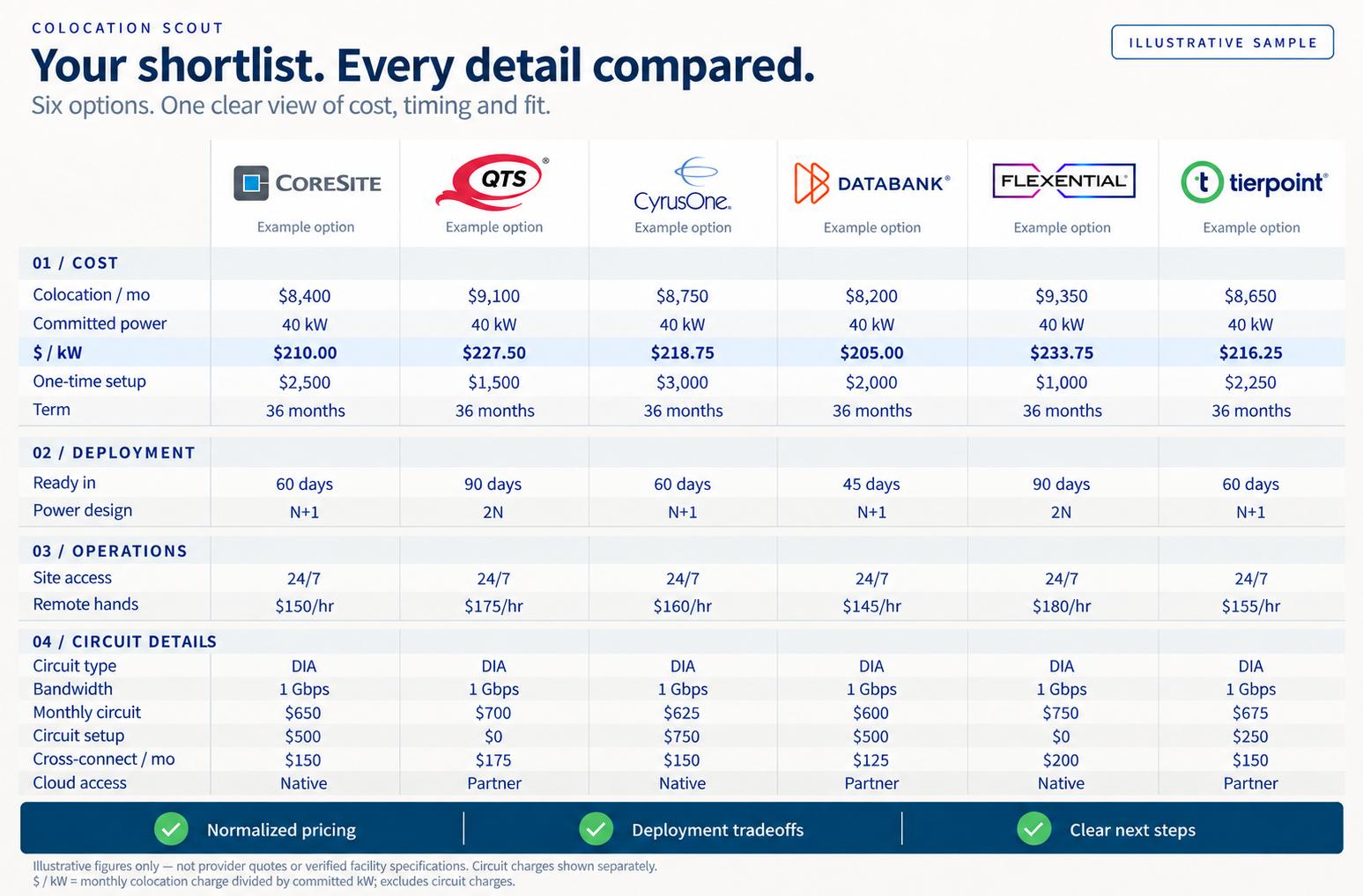
Most colocation in Chicago is quoted, not posted. The provider below is the exception: it publishes a monthly price on its own website, and every row links to that page. It is a smaller regional operator. The large operators here do not publish prices at all, so read these as a floor and a sanity check, not as what an enterprise contract lands at.
| Monthly | Provider | Offer | Power included | Per usable kW | Bandwidth |
|---|---|---|---|---|---|
| $1,400 | GigeNET | Full rack, 40U. Chicago. $1,500 setup | 20A at 120V, A+B (1.92 kW usable) | $729 | 1 Gbps port |
Each price was read on the provider's own page on the date shown. Usable kW is 80% of the circuit rating, with a redundant A+B pair counted once, and is only worked out where the provider states both amps and volts. "From" is the provider's own word for a starting price. Providers whose networks carry spam or abuse flags are left out whatever their price. A posted price is not availability, and bundles differ in bandwidth and power, so compare the whole row rather than the first column. How power is billed is covered in how colocation power is billed.
Send it over and a scout will tell you how it compares with these posted prices and with the published benchmarks for this market. There is no obligation.
Who is actually plugged in across Chicago
A building existing and a building being connected are different facts, and only one of them decides whether your traffic can get where it needs to go cheaply. These figures come from PeeringDB, which the network operators themselves maintain, so every row below links to the building's own public entry.
| Measure | Figure | What it means |
|---|---|---|
| Buildings listed | 57 | Registered in PeeringDB across Chicago, by 34 operators |
| Buildings with a network present | 40 | 17 carry no network presence, which usually means single tenant or simply unregistered |
| Network presences | 802 | Counted per building, so a carrier in three buildings counts three times |
| Internet exchange presences | 61 | Where you can reach many networks through one port instead of many cross-connects |
| Carrier presences | 44 | The physical transport choice you can buy without leaving the building |
| In the densest building | 42% | Equinix CH1/CH2/CH4 - Chicago holds 335 of the market's network presences |
The most connected buildings here
| Networks | Building | Operator | Exchanges | Carriers |
|---|---|---|---|---|
| 335 | Equinix CH1/CH2/CH4 - Chicago | Equinix, Inc. | 10 | 13 |
| 102 | Digital Realty CHI (350 E Cermak) | Digital Realty | 7 | 5 |
| 75 | CoreSite - Chicago (CH1) | CoreSite | 6 | 3 |
| 44 | Equinix CH3 - Elk Grove | Equinix, Inc. | 2 | 3 |
| 22 | Netrality Chicago - 717 S Wells | Netrality Data Centers | 4 | 2 |
| 20 | Northwestern University co-location facility | 710facility@ittns.northwestern.edu | 0 | 0 |
| 19 | 365 Data Centers Chicago (CH6) | 365 Data Centers | 2 | 0 |
| 17 | Digital Realty CH1 - Chicago | Digital Realty | 2 | 1 |
From PeeringDB, which is maintained by the network operators present in these buildings rather than by the landlords, which is what makes it worth more than a directory. Two limits. Entries are voluntary, so a building showing no networks may be single tenant or may simply never have registered. And a network being present says nothing about whether the building has space, power or a price for you: that is still a call.
Q1 2026 market profileWhy Chicago remains a primary data center market
Chicago combines central U.S. geography with major long-haul and metro fiber routes, cloud and carrier ecosystems, deep enterprise demand, and proximity to financial-services infrastructure. It is often shortlisted for Midwest operations, national application delivery, disaster recovery, regulated workloads, and low-latency connectivity requirements.
CBRE reported 910.6 MW of wholesale inventory in Q1 2026, up 37.7% year over year. Vacancy fell to 2.2%, and only 19.8 MW remained available across the market. Demand from hyperscale, AI, enterprise, and financial-services buyers continued to absorb new capacity.
910.6 MW
Total wholesale inventory, placing Chicago fourth among U.S. colocation markets.
37.7% growth
Year-over-year inventory expansion, equal to 249.2 MW of added capacity.
2.2% vacancy
Available capacity tightened despite significant new inventory.
19.8 MW available
Market-wide availability reported at the end of Q1 2026.
Source: CBRE Global Data Center Trends 2026. Figures describe the metro market, not a specific facility.
Power delivery changes the shortlist
CBRE reports that ComEd power-delivery timelines can extend to 2032 or later, require significant financial commitments, and constrain near-term development. That makes existing energized capacity and credible near-term phases strategically valuable.
Do not treat a planned Chicago phase as an alternative to live capacity until the utility path, financial commitments, construction milestones, and contractual remedies are clear.
- Confirm whether the offered capacity is energized, under construction, or dependent on future utility work.
- Identify every external milestone behind the proposed service date.
- Understand deposits, guarantees, take-or-pay terms, and other commitments tied to future power.
- Verify whether expansion is in the same building, campus, or a different submarket.
- Define remedies if the provider misses a delivery commitment.
Chicago's expanding western submarkets
Development continues to move west into power-accessible areas such as Elk Grove Village, Northlake, and Hoffman Estates. Improved fiber connectivity supports that expansion, giving buyers more campus and capacity options beyond the urban core.
Submarket choice should be workload-driven. A downtown or established carrier location may serve latency and interconnection needs. A western campus may offer a different power profile, expansion path, operating environment, and cost structure. The facility search should compare the complete network and operational design, not only distance from downtown.
Chicago pricing needs a complete scope
CBRE reported Chicago asking rates of $200 to $230 per kW per month for 250 to 500 kW requirements in Q1 2026, the highest rate band among the four major North American markets in its report. Chicago rents increased 14.7% year over year as demand tightened available supply.
That benchmark is a planning signal, not a quote. Facility design, capacity status, density, network, term, and included services can push a real offer outside the published range.
- Base committed power and any metered or pass-through components.
- Cage, suite, cabinets, containment, or custom buildout.
- Cross-connects, carrier ports, cloud access, and diverse circuits.
- Installation, migration support, remote hands, and after-hours access.
- Annual escalators, power adjustments, renewal rates, and expansion pricing.
- Deposits or financial commitments tied to future phases.
When Chicago is the strongest fit
Chicago is compelling when the workload benefits from central geography, Midwest operations, financial-services proximity, dense network connectivity, or balanced national reach. It can also be a strong recovery location when paired with an East Coast or southern primary site, subject to latency and risk design.
Compare Chicago with Dallas-Fort Worth for central U.S. coverage and expansion. Compare it with Northern Virginia for interconnection-heavy architectures. Compare it with Atlanta when application geography and the southern operating footprint matter more than Midwest proximity.
For a second site close to Chicago, Wisconsin is about ninety miles north and on a different regulator. St. Louis is a smaller carrier hotel market with real interconnection depth.
Risks to resolve before shortlisting a facility
- Power timing: a long utility horizon can make announced supply irrelevant to a near-term project.
- Price pressure: tight availability and strong demand are increasing asking rates.
- Submarket network fit: confirm carrier and cloud connectivity at the exact campus.
- Development approvals: zoning, entitlement, and community scrutiny can affect new projects.
- Expansion certainty: reserve future capacity contractually when growth depends on it.
A facility-ready Chicago brief
- Initial and expansion power with hard delivery dates.
- Rack density, cooling, redundancy, and maintenance requirements.
- Latency targets, carriers, cloud access, cross-connects, and diverse routes.
- Preferred urban, established suburban, or western growth submarkets.
- Security, compliance, site access, and operating support.
- Term, ramp, escalators, renewal protection, and delivery remedies.
Price live capacity against credible future phases, then compare Chicago with DFW or another market before accepting a long utility dependency or an aggressive rate.
Chicago by the numbers
Chicago is the most counterintuitive of the four largest US markets. Power is cheap, land is cheap, and asking rents are the highest in the country. Understanding why is most of what you need to know to buy here well.
| Measure | Figure | Context |
|---|---|---|
| Asking rent, 250 to 500 kW | $200 to $230/kW-mo | The highest published band of the top four US markets |
| Asking rent change | Up 14.7% | The steepest increase of the top four in Q1 2026 |
| Market rank | Fourth largest | Overtook Phoenix on inventory in Q1 2026 |
| Industrial power tariff | About $0.069/kWh | Roughly 30% below the Northern Virginia band |
| Data center land | $500K to $1M/acre | Established corridors, a fraction of Northern Virginia |
| Large-load queue at ComEd | About 14 GW | Across roughly 75 applications, against a market near 2 GW |
Rate, rate change and ranking from CBRE Global Data Center Trends 2026. Tariff, land and queue figures are market reported and vary by corridor and substation. Some commentary cites Chicago rent growth above 30%; we use CBRE's 14.7% because it is published on a consistent 250 to 500 kW basis, and flag the discrepancy rather than choosing the larger figure.
Roughly 14 GW of large load is queued to connect in a market that operates around 2 GW. That ratio, not the cost of electricity or land, is what sets the price. What is scarce in Chicago is a connection date.
Power delivery is the constraint, and the timeline is long
ComEd is executing a substation expansion program of roughly $1 billion centered on Elk Grove, targeted for completion in late 2026. That will help. It will not clear a 14 GW queue, and some newly served projects currently face power delivery dates out to 2031 or later.
For a buyer this changes what is worth negotiating. In a market with available capacity you negotiate rate. In Chicago you negotiate the date, the substation position, and the remedies if the date moves. A provider holding energized capacity today is selling something structurally different from a provider holding a queue position, even when the rate card looks similar.
Which substation serves this hall, and what is its committed load? Is my capacity ahead of or behind the Elk Grove work? Is the power date contractual, and what happens if it slips? Confirm dates with the serving utility for the specific site and load rather than relying on a market average, because these vary substantially.
The Illinois tax exemption is a live uncertainty
Illinois has run one of the most effective data center incentive programs in the country, and its future is currently unsettled. If your business case leans on it, treat that as a modeled risk rather than an assumption.
| Element | Detail |
|---|---|
| Benefit | 10.25% sales and use tax exemption on qualifying equipment |
| Qualification | At least $250M invested and at least 20 new staff |
| Track record | More than $11B in build commitments since 2019 |
| Current status | A two-year suspension has been proposed, effective July 1, 2026 |
Program terms and the proposed suspension are as reported; see Capitol News Illinois on data centers in line for state tax credits. This is not tax advice. Verify the current statutory position and your own qualification with counsel, because it may have changed since this page was reviewed.
The submarkets, and what each is good for
Elk Grove Village
West of O'Hare and the center of gravity for the market, with a large share of incentive-qualified sites and the focus of ComEd's substation program. The corridor where delivery dates are most likely to improve first.
Chicago core and carrier hotels
Downtown interconnection and peering density, including major carrier hotel facilities. The answer for network-heavy and latency-sensitive requirements.
Northwest suburbs and the O'Hare ring
Established multi-tenant colocation for cabinet and private cage colocation deployments, with solid carrier choice and shorter lead times than greenfield campuses.
Outer collar counties
Where the largest new campuses are staged, including a 480 MW development on 160 acres in Grayslake targeted to be operational by 2027, about 40 miles north of the city.
Campus examples come from public announcements and are included to show where development is concentrated. An announced project is not deliverable capacity. See how we verify capacity.
Why buy in Chicago at all
Given the queue and the rents, the case for Chicago has to be specific. It usually is one of these.
- Central US latency: a genuine geographic advantage for serving the middle of the country and for east-west network paths.
- Interconnection depth: Chicago's carrier hotel ecosystem is one of the strongest outside Northern Virginia, particularly for financial networks.
- Financial market proximity: for trading and market-data workloads, specific Chicago facilities are effectively mandatory rather than optional.
- Climate: a cooler climate supports more hours of economizer operation, which helps operating efficiency for air-cooled designs.
- Cheap inputs once connected: if you can secure a date, the underlying power and land economics are genuinely favorable.
If none of those apply to your workload, the honest answer is that Chicago is the wrong market this cycle. Paying the highest rents in the country and waiting years for power only makes sense when the location itself is doing work for you. The pricing benchmarks page sets out what the alternatives cost.
What has been announced in Chicago
Announcements are not filings. Nobody has to build what they announce, the figure is the one the developer chose to publish, and the date moves. They are here because megawatts are what a requirement is measured in, and because the size of what is coming changes who will take your call. Every figure below links to a published report that states it, and was checked against at least one other independent report before it was written down.
| Capacity | Operator | Project | What was announced |
|---|---|---|---|
| 100 MW | Aligned Data Centers | ORD1, Northlake | 18.5 acres, first building 48 MW expandable to 60 MW |
| 36 MW | STACK Infrastructure | CHI02, Elk Grove Village | 263,000 SF on 18 acres, a mile from its CHI01 campus |
Announced capacity is collected by hand from trade reporting and company statements, and each figure links to the report it came from. It is kept apart from the permit record below and never added to it: one is a document a jurisdiction issued, the other is a plan a company published. Neither is availability.
Every Chicago facility we track
169 data centers across Chicago, from our verified inventory. It is the layer that says whether a building exists yet, which no permit record answers directly.
| Status | Facilities | What it means for a search |
|---|---|---|
| Operational | 75 | Standing and running. The only layer that can hold a requirement this year |
| Under construction | 13 | Steel is up. Reachable for a date 6 to 18 months out, and usually pre-leasing now |
| Planned | 81 | Announced or entitled, not yet built. Treat every date on these as a forecast |
| Building area on file | 29,150,785 SF | Across the 92 facilities where a size is recorded, of 169 |
| Largest single building | 1,247,000 SF | Digital Realty, Franklin Park |
Operators with the most facilities here: CyrusOne (20), Digital Realty (14), T5 Data Centers (14), PowerHouse Data Centers (7), Aligned Data Centers (5), Compass Datacenters (5), EdgeConneX (5), Equinix (5), NTT Global Data Centers (5), Stream Data Centers (5).
Where they cluster: Elk Grove Village (32), Chicago (28), Grayslake (11), Aurora (10), Franklin Park (9), Little Rock Township (9).
The largest buildings coming to this market
94 facilities here are under construction or planned. These are the ten largest by floor area, and a size on file is not a promise of a delivery date.
| Operator | Status | Building size | Where |
|---|---|---|---|
| Digital Realty | Planned | 698,000 SF | Chicago, IL |
| CloudHQ | Under Construction | 566,800 SF | Mount Prospect, IL |
| CloudHQ | Planned | 566,800 SF | Mount Prospect, IL |
| CloudHQ | Planned | 566,800 SF | Mount Prospect, IL |
| QTS | Planned | 465,000 SF | Chicago, IL |
| Chirisa Technology Parks | Planned | 460,000 SF | Volo, IL |
| 2222 S Indiana Avenue | Planned | 411,744 SF | Chicago, IL |
| Digital Realty | Planned | 400,000 SF | Franklin Park, IL |
| Prime Data Centers | Under Construction | 381,141 SF | Elk Grove Village, IL |
| T5 Data Centers | Under Construction | 300,000 SF | Northlake, IL |
From our verified inventory rather than from a public record, so these rows carry no filing link and street addresses are held back. These buildings are verified, which is not the same as their space being available: every facility above may be full, pre-leased, or closed to your size. Finding out is a call, not a lookup. See what a verified building does and does not mean.
What the public construction record shows in Chicago
The City of Chicago publishes its building permits, and unlike a suburb's portal the city file is the right target here: the market's stock is downtown carrier hotels and office-to-data-center conversions, not exurban campuses, so the work shows up in the city's own record. That record reads exactly like the market this page describes. The permit descriptions name office-to-data-center conversions in plain language, and the operators filing them are the same landlords a shortlist would name. Two limits to hold in mind before quoting any of it: a permit proves construction, not available space, and the low count of recent filings is a real feature of a retrofit market with a long power queue rather than a gap in the record.
City of Chicago building permits, filed downtown and on the near-South Side where the market's carrier hotels and office-to-data-center conversions sit. Every figure below is a count of filings we collected ourselves, and every row links to the record it came from.
| Measure | Figure | What it means |
|---|---|---|
| Filings we track | 217 | Deduplicated. Across 2 sources, May 2006 to June 2026 |
| Filed in the last 12 months | 7 | The live rate of construction activity, which is the number that moves |
| Tenant fit-out filings | 78 | A customer is landing in a named building. The strongest signal in the set |
| New building filings | 10 | Shell and site work, which is capacity two years out, not now |
| Distinct addresses | 62 | Separate sites in the record, not separate buildings |
| Largest floor area filed | 317,000 SF | One permit, not a campus total. Floor area is published far more often than capacity |
| Operators we can name | 10 | 107 of 217 filings name a recognizable operator. The rest name an engineer, a builder or a holding company |
| Filings with no date published | 8 | The source publishes the facility, not the filing date |
Operators appearing by name: QTS (48), Digital Realty (27), AT&T (14), CoreSite (9), Equinix (4), Aligned (1), EdgeConneX (1), Microsoft (1).
The most recent filings on the record
Collected from City of Chicago building permit records and Village of Elk Grove Village permit records. A permit or air-register entry documents a site or proposed work. It does not establish current construction or available space, and no public filing anywhere discloses what is contractible at a named building. That answer comes from an operator call, which is the part we do by hand. See how we verify capacity.